Data Center Cooling Solutions for High-Density AI & HPC
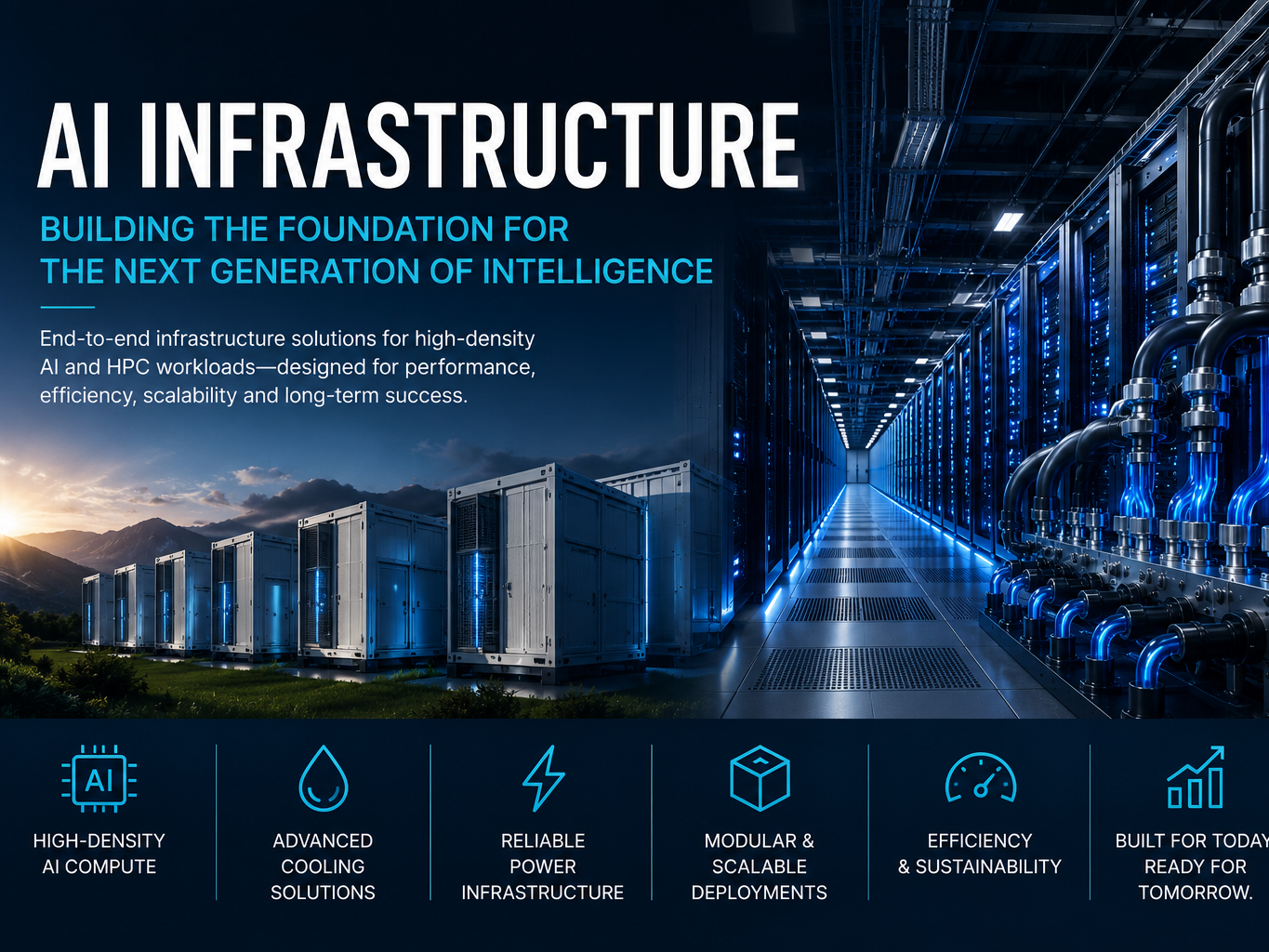
As AI and high-performance computing continue to drive higher GPU densities and rack power, traditional air cooling is increasingly being pushed to its limits. Modern data center cooling requires infrastructure designed for higher thermal loads, greater efficiency and the evolving demands of AI workloads.
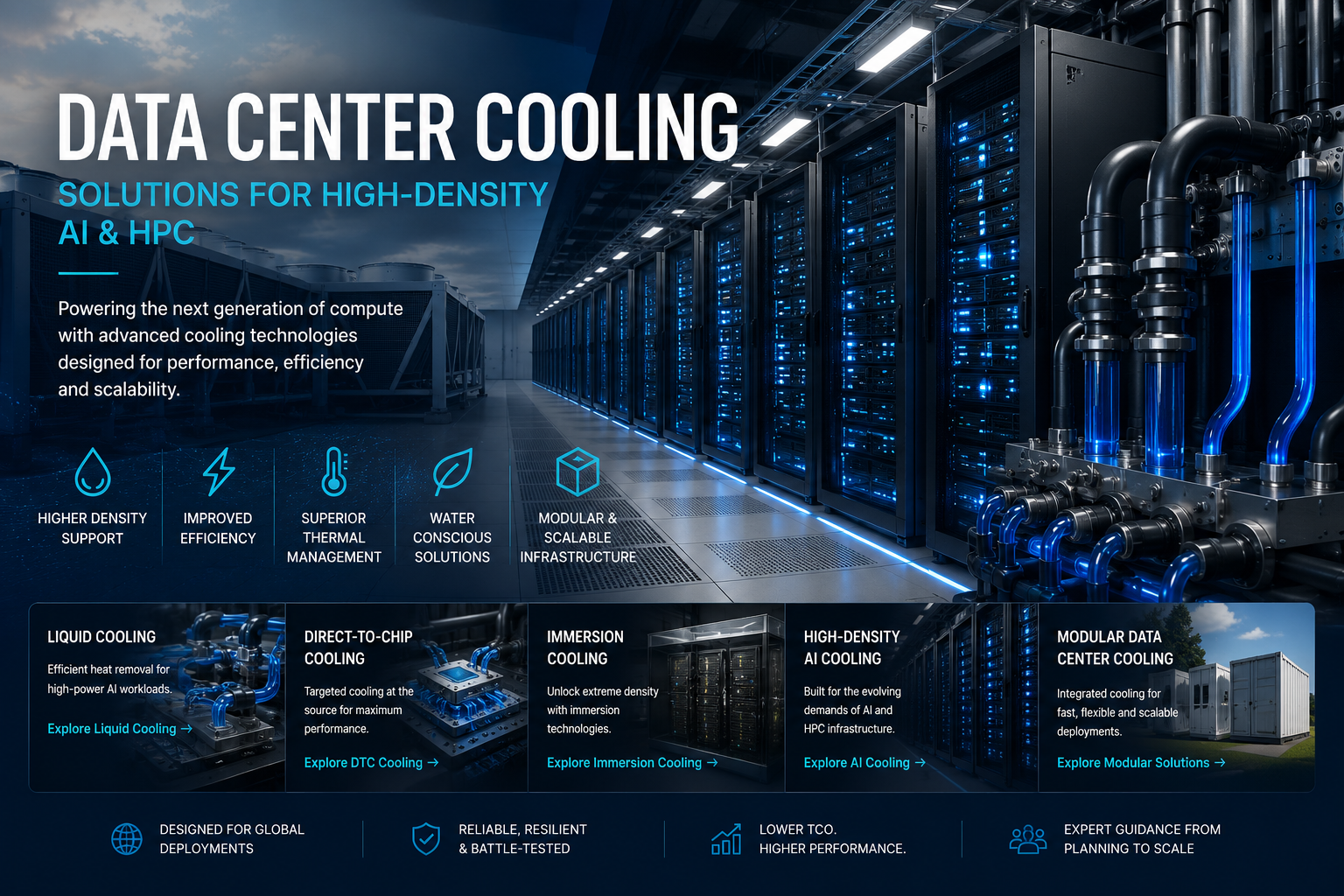
We help organizations evaluate data center cooling solutions for high-density compute environments, including liquid cooling, direct-to-chip cooling, immersion cooling and advanced modular infrastructure.
Data Center Cooling for the Next Generation of Compute
AI infrastructure is changing the economics and engineering requirements of data centers. Next-generation GPUs can generate significantly more heat than conventional enterprise servers, while high-density racks can push cooling requirements far beyond traditional air-cooled architectures.
Choosing the right cooling approach depends on factors including rack density, GPU platform, total IT load, facility design, available power, water constraints, deployment timeline and long-term scalability.
We help organizations understand these requirements and identify the data center cooling technology best suited to their project.
Data Center Cooling Solutions
Liquid Cooling
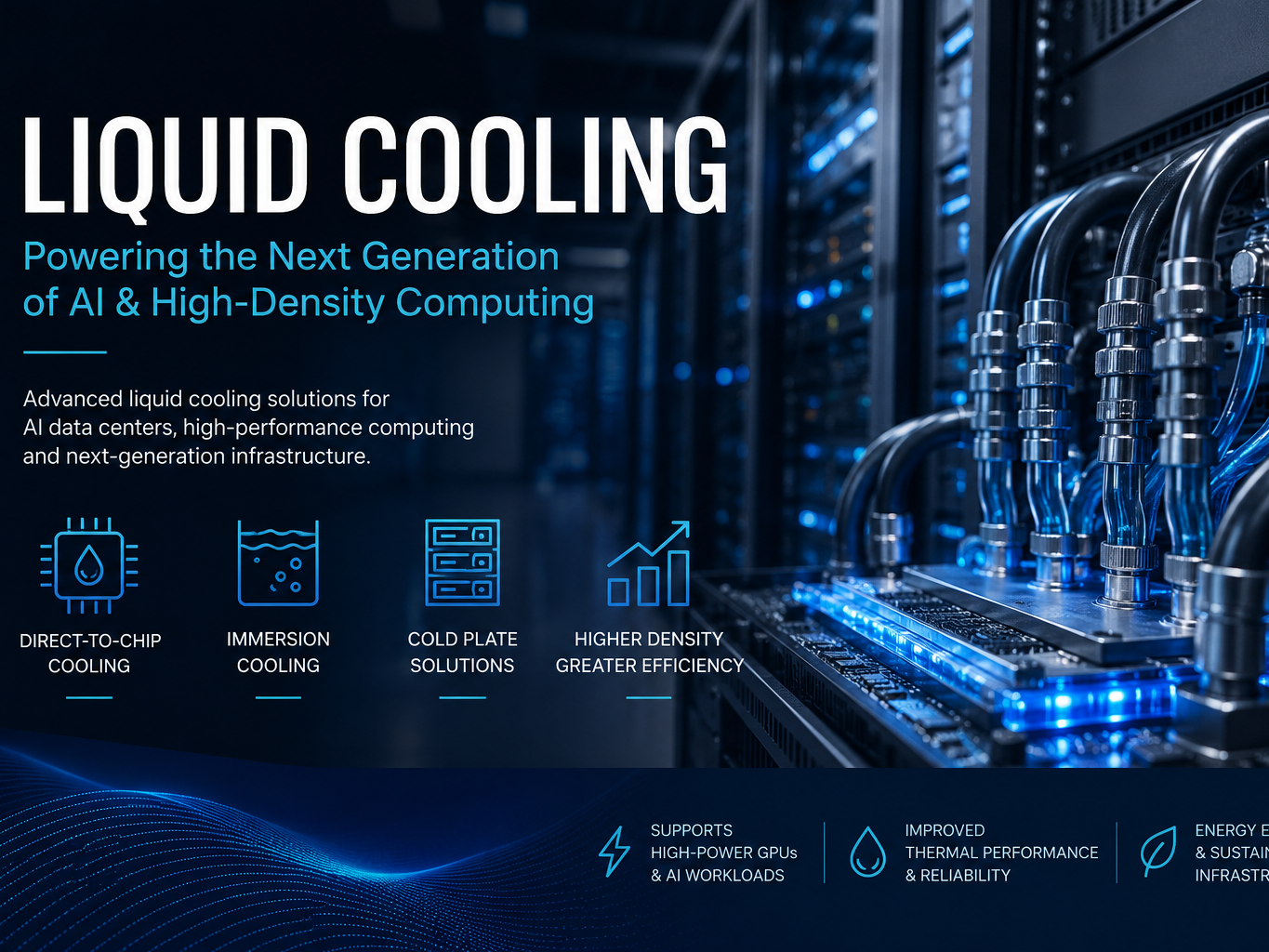
Liquid cooling for data centers uses liquid to remove heat more efficiently than traditional air-based systems. It can support higher rack densities and help data centers manage the thermal requirements of AI and HPC workloads.
Liquid cooling architectures can include direct-to-chip systems, cold plates, cooling distribution units and other supporting infrastructure.
Direct-to-Chip Cooling
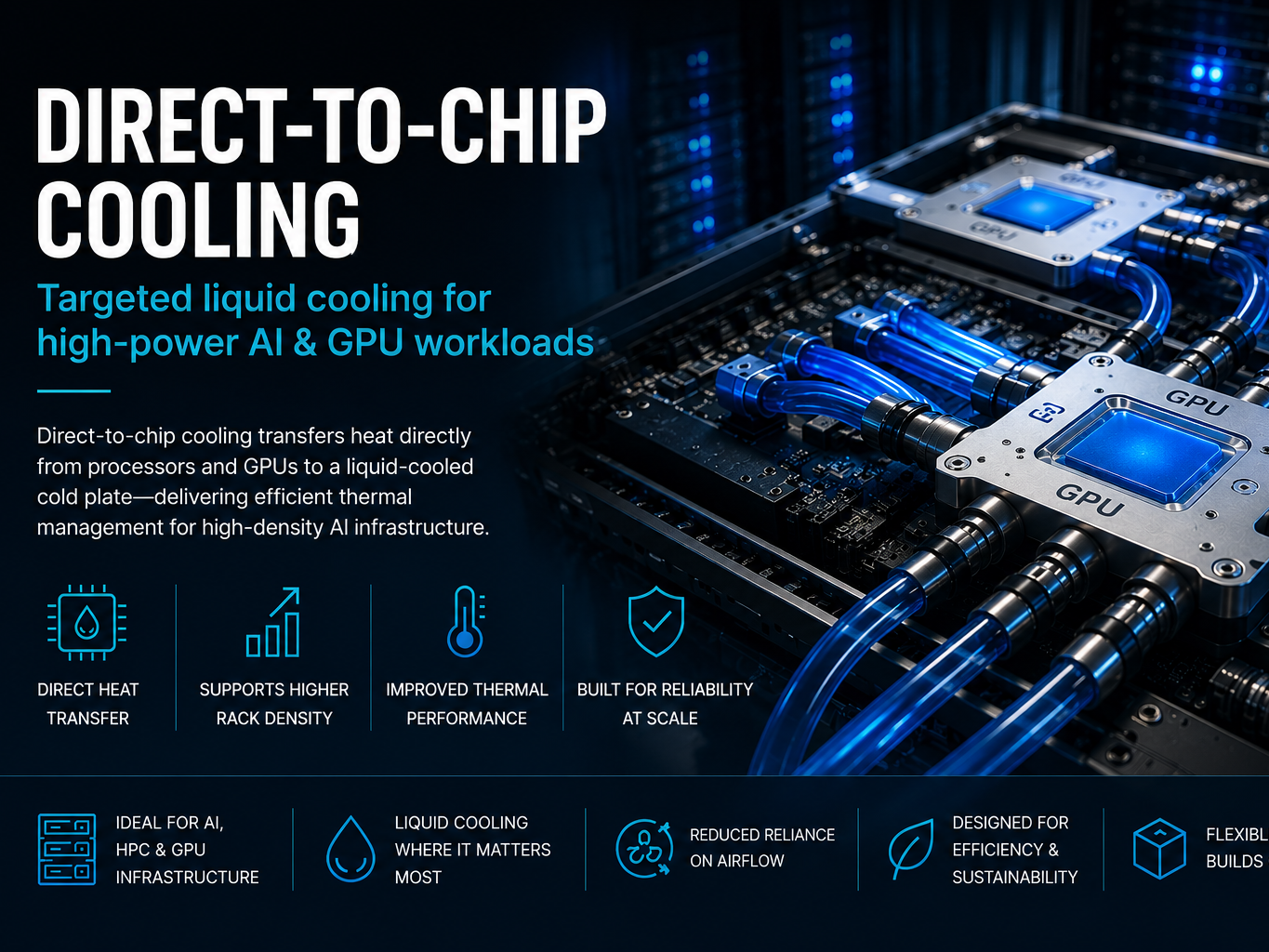
Direct-to-chip cooling transfers heat directly from high-power processors and GPUs to a liquid-cooled cold plate. This approach can provide efficient thermal management for high-density AI servers while integrating with existing or new data center infrastructure.
Immersion Cooling
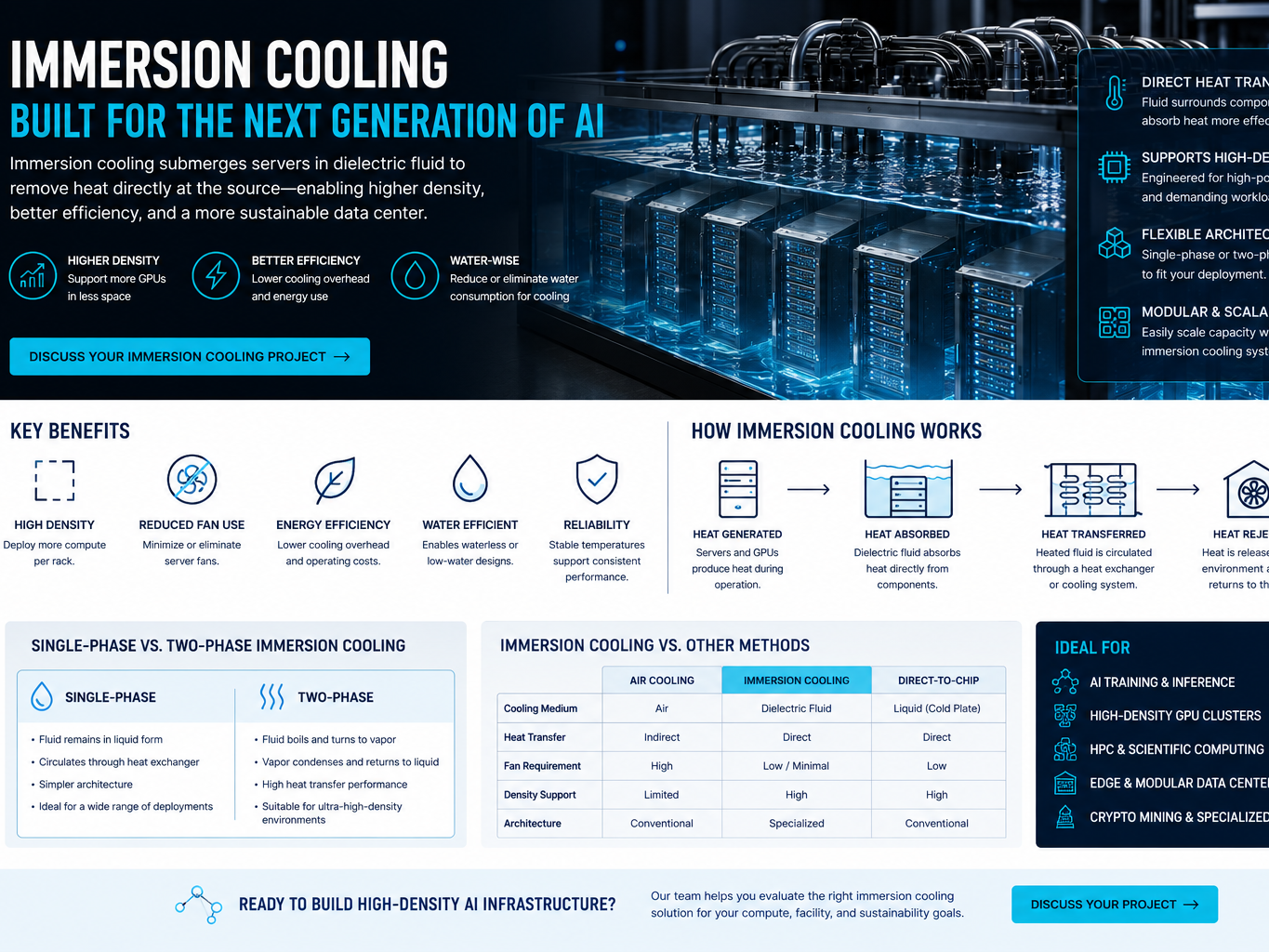
Immersion cooling places servers or selected components in a dielectric cooling fluid, allowing heat to be transferred directly from the equipment into the cooling medium.
Single-phase and phase-change immersion cooling can be considered for applications where extremely high compute density, energy efficiency or space constraints make conventional cooling challenging.
High-Density AI Cooling
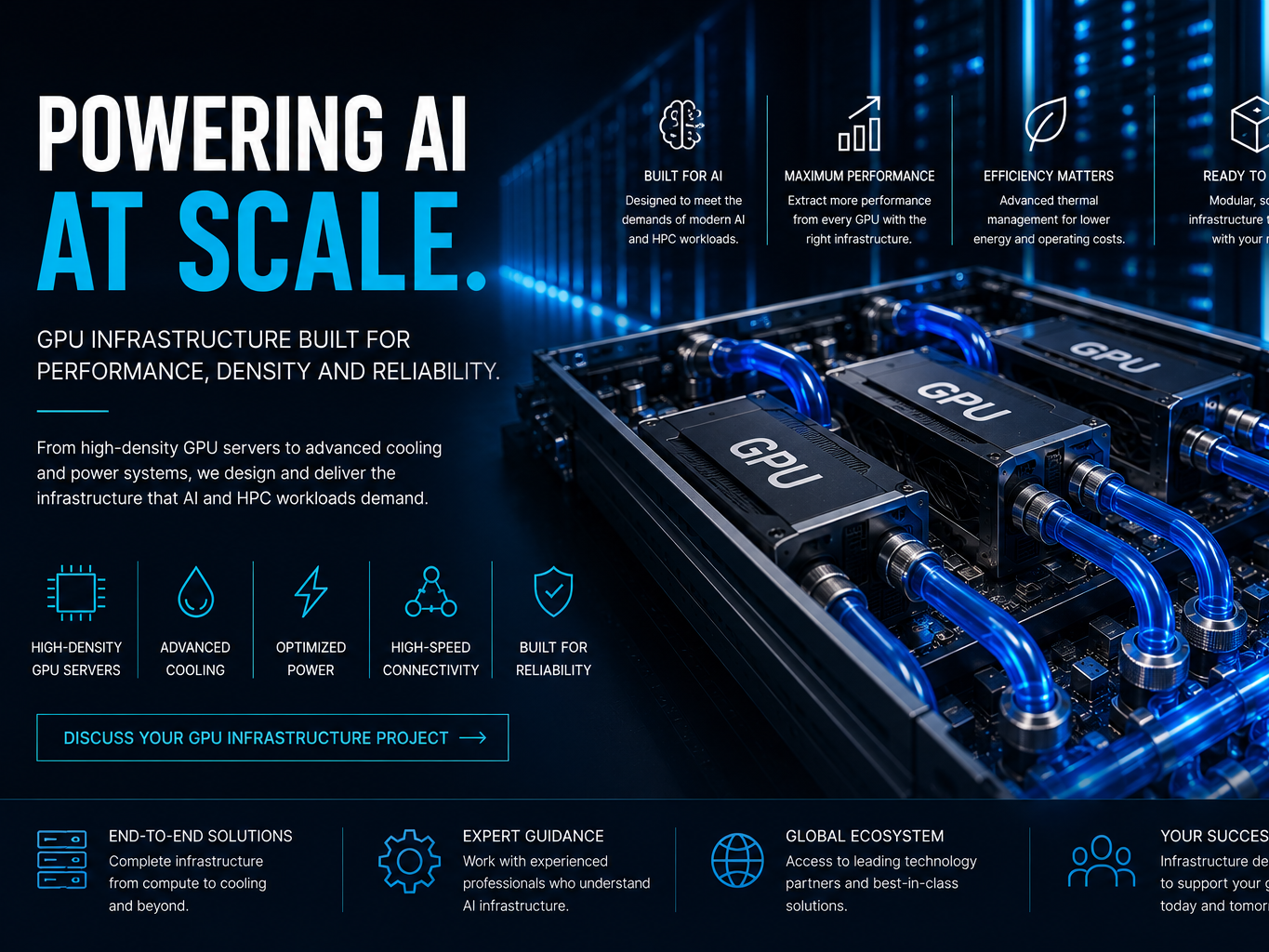
The growth of AI is creating a new class of high-density data center cooling requirements. As GPU power and rack density increase, operators need cooling architectures capable of handling substantially higher thermal loads.
For AI and HPC deployments, cooling should be considered as part of the infrastructure architecture from the beginning rather than added after the compute environment has been designed.
Modular Data Center Cooling
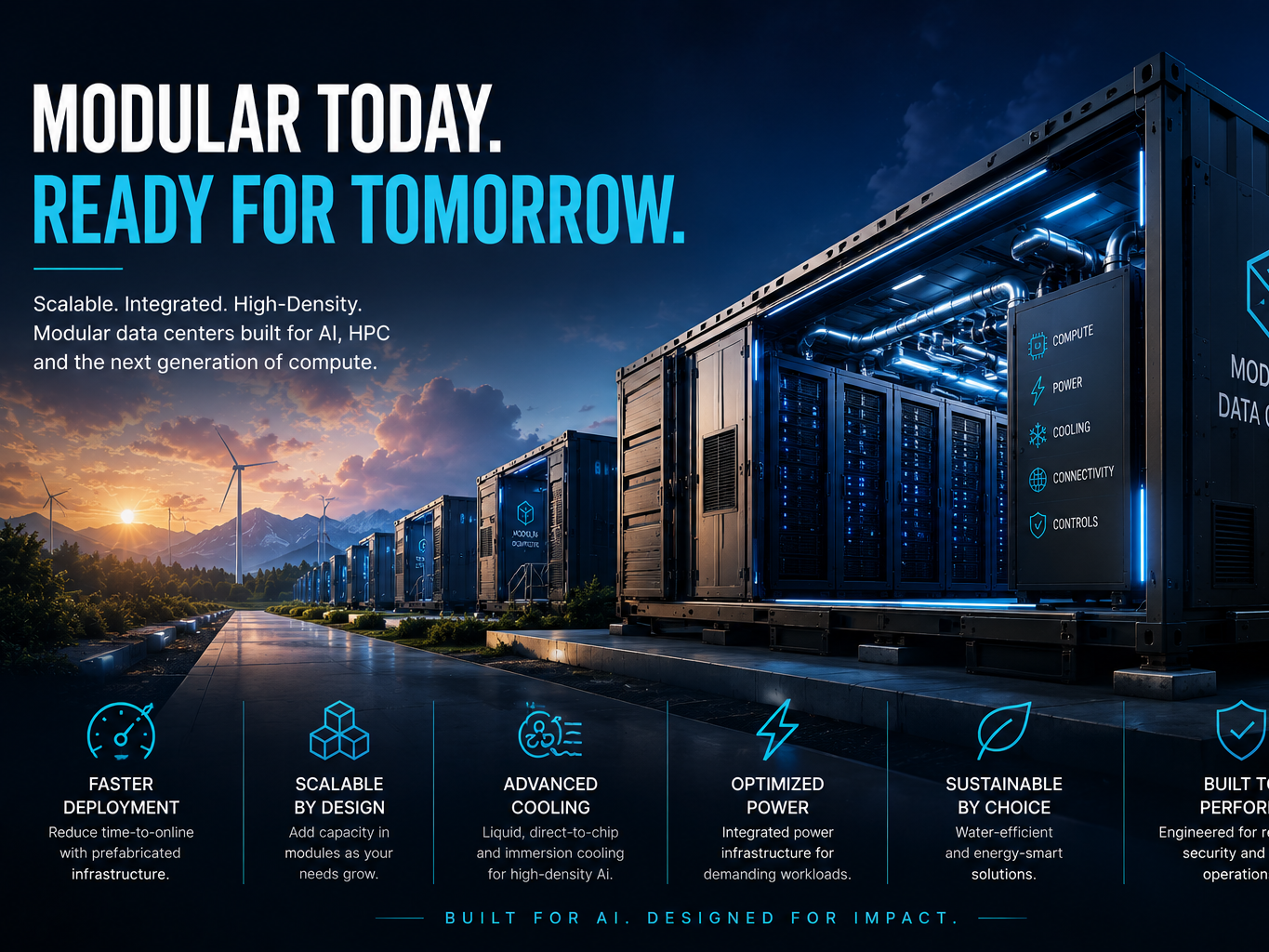
Modular and containerized data centers can integrate compute, power and cooling infrastructure into a scalable deployment model.
For organizations building AI infrastructure in locations where speed, flexibility, space or site constraints are important, modular data center cooling solutions can provide an alternative to conventional facility designs.
Liquid Cooling vs. Air Cooling
Air cooling remains an effective solution for many conventional data center environments. However, increasing AI and GPU densities are creating situations where air cooling becomes less practical or requires significantly more infrastructure to remove the same amount of heat.
• Liquid cooling can provide several potential advantages for high-density environments:
• Higher thermal transfer efficiency
• Support for higher rack densities
• More efficient cooling of high-power GPUs and CPUs
• Reduced dependence on large volumes of airflow
• Potentially improved data center energy efficiency
• Greater flexibility for future high-density AI deployments
The right solution depends on the application. Direct-to-chip, immersion, hybrid and advanced air-cooling architectures each have different advantages and implementation requirements.
Why Data Center Cooling Matters for AI Infrastructure
Cooling is no longer simply a facility-level consideration. For AI infrastructure, it can influence:
Compute density
How much processing capacity can be deployed within a given rack or data center footprint.
How much processing capacity can be deployed within a given rack or data center footprint.
Energy efficiency
How effectively infrastructure converts power into usable compute while managing the heat generated by that compute.
How effectively infrastructure converts power into usable compute while managing the heat generated by that compute.
Water consumption
Whether a cooling architecture depends on significant water usage, an increasingly important consideration for data center development.
Whether a cooling architecture depends on significant water usage, an increasingly important consideration for data center development.
Scalability
Whether the cooling infrastructure can support future increases in GPU power and rack density.
Whether the cooling infrastructure can support future increases in GPU power and rack density.
Deployment speed
How quickly cooling and supporting infrastructure can be deployed alongside new AI compute capacity.
How quickly cooling and supporting infrastructure can be deployed alongside new AI compute capacity.
Waterless and Water-Efficient Data Center Cooling
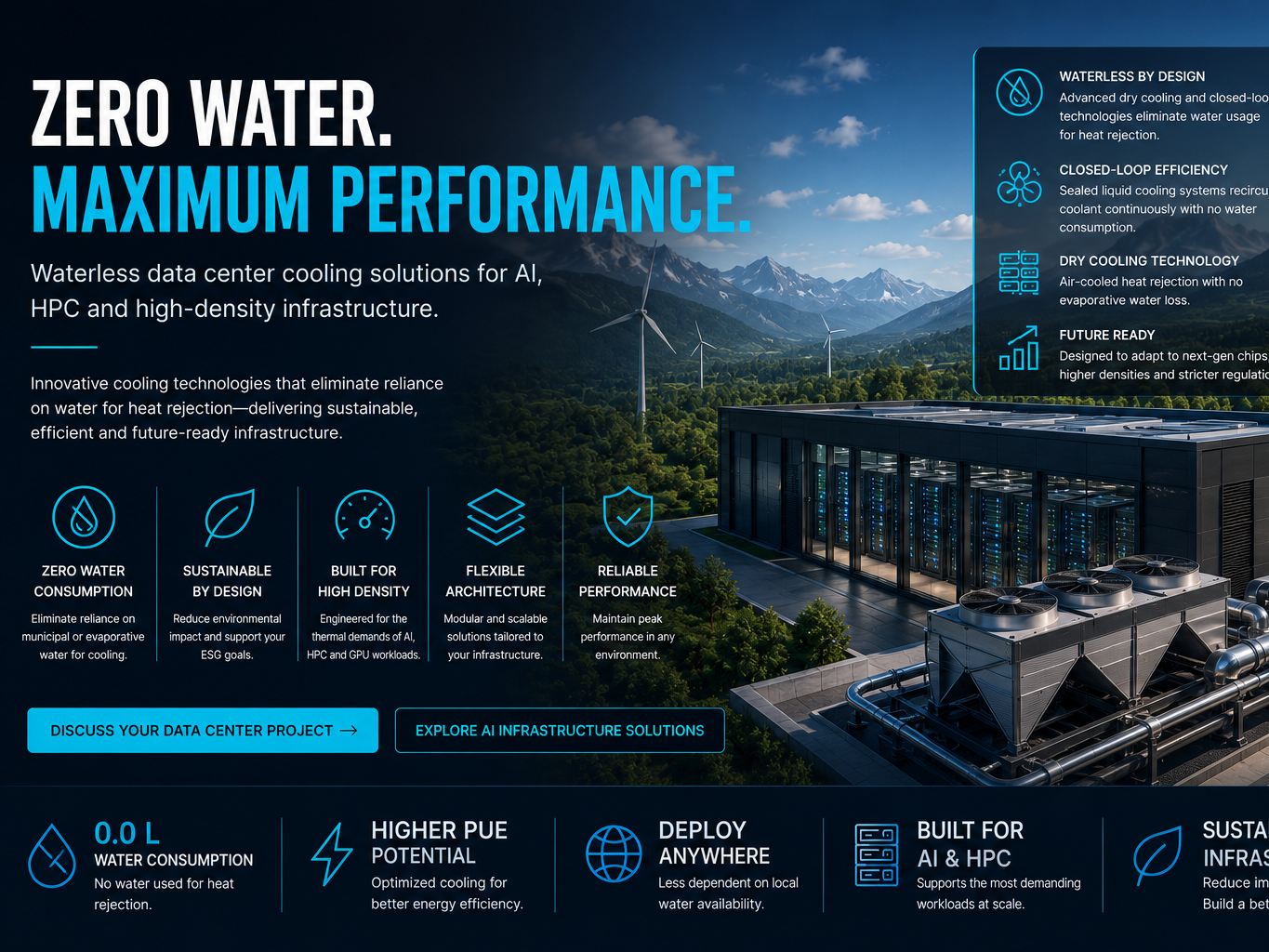
Water availability is becoming an increasingly important consideration when planning new data center capacity.
Organizations evaluating AI infrastructure may therefore need to consider not only cooling performance, but also water consumption, site availability and long-term sustainability.
Water-efficient and waterless cooling architectures can help operators address these constraints while supporting high-density computing environments.
Choosing the Right Data Center Cooling Solution
There is no single cooling architecture that works for every data center.
The right approach depends on your:
• GPU or CPU platform
• Rack power and density
• Total IT load
• Facility size
• Location and climate
• Available power and water
• Existing data center infrastructure
• Deployment timeline
• Expansion requirements
• Capital and operating cost objectives
For this reason, cooling should be evaluated alongside the broader AI data center infrastructure strategy.
Planning a High-Density Data Center?
Whether you are developing a new AI data center, expanding GPU capacity or evaluating cooling options for an existing facility, we can help you understand the available technologies and identify the solutions worth evaluating.
Tell us about your project, and we can connect you with experienced technology providers when there is a strong fit.
FAQs
What is data center cooling?
Data center cooling is the infrastructure used to remove heat generated by servers, GPUs, networking equipment and other IT systems and maintain appropriate operating temperatures.
Why do data centers need cooling?
Computing equipment converts electrical power into heat. Without adequate cooling, temperatures can rise beyond equipment operating limits, potentially affecting performance, reliability and equipment life.
What are the main types of data center cooling?
Common approaches include air cooling, liquid cooling, direct-to-chip cooling, immersion cooling, rear-door heat exchangers and hybrid cooling architectures.
When does a data center need liquid cooling?
It depends primarily on processor and rack thermal loads rather than a universal rack-density threshold. Liquid cooling becomes increasingly relevant when the required airflow, fan power or facility cooling capacity becomes impractical for the planned workload.
Is liquid cooling better than air cooling?
Not universally. Air cooling remains appropriate for many workloads. Liquid cooling becomes increasingly attractive as processor power and rack density increase.
Can liquid cooling be used in an existing data center?
Yes. Retrofit options exist, although the feasibility depends on the existing power, cooling, rack, plumbing and facility infrastructure. CDUs and other systems can be used to integrate liquid-cooled servers with existing facility infrastructure.
Does liquid cooling eliminate the need for air conditioning?
Not necessarily. Direct-to-chip cooling removes heat from selected components, but other equipment and parts of the facility may still generate heat that needs to be managed with air cooling.
How do you choose the right data center cooling solution?
The decision should consider GPU/CPU platform, rack density, IT load, climate, available power and water, existing infrastructure, deployment timeline, scalability and total cost of ownership.