Immersion Cooling System for AI, HPC & Data Centers
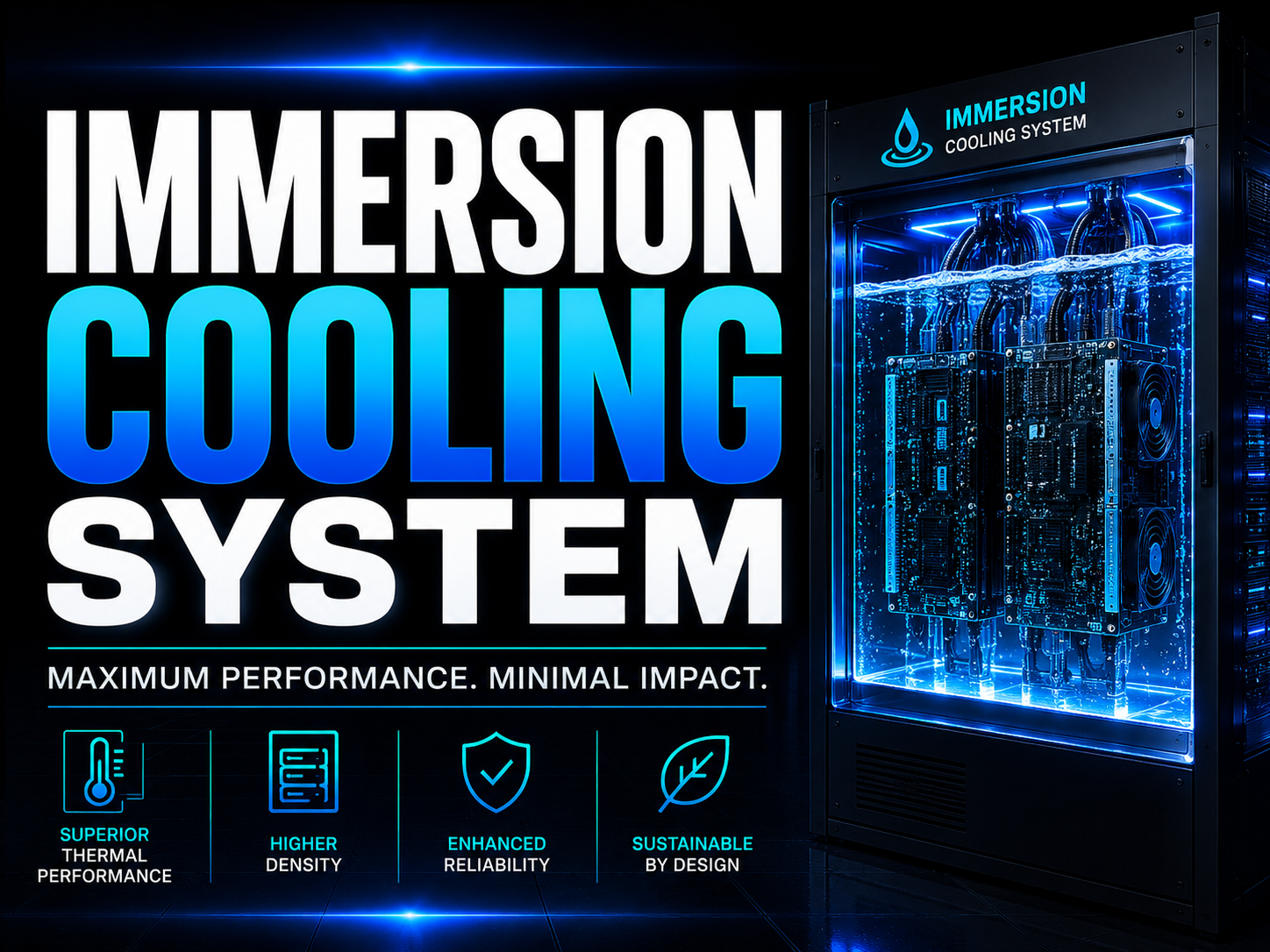
An immersion cooling system cools servers by placing the equipment directly into a specially engineered dielectric cooling fluid.
As AI and HPC workloads drive higher server and rack densities, immersion cooling provides an alternative to traditional air cooling and can support demanding environments where managing heat efficiently is becoming increasingly difficult.
Want to know more? Contact me.
What Is an Immersion Cooling System?
An immersion cooling system uses a non-conductive dielectric fluid to remove heat directly from servers and other computing components.
Instead of using air to carry heat away from the equipment, the cooling fluid surrounds the hardware and transfers heat into the cooling system.
A typical system can include:
• Immersion tanks
• Dielectric cooling fluid
• Pumps and circulation systems
• Heat exchangers
• Coolant distribution equipment
• Facility heat-rejection systems
There are two main approaches: single-phase and two-phase immersion cooling.
How Does Immersion Cooling Work?
The basic process is straightforward:
Server → Dielectric Fluid → Heat Exchanger → Facility Cooling → Heat Rejection
The servers generate heat while operating. The dielectric fluid absorbs that heat and transfers it through the cooling system.
The exact architecture depends on the equipment, fluid, rack density and facility requirements.
Why Use Immersion Cooling?
Immersion cooling can be particularly attractive for high-density computing, where conventional air cooling requires significant airflow and cooling infrastructure.
Potential benefits include:
• High thermal transfer capacity
• Support for high-density servers
• Reduced reliance on room airflow
• Compact cooling infrastructure
• Potential energy savings
• Suitable for certain AI and HPC environments
The actual performance and efficiency depend on the system design and operating conditions.
Single-Phase vs. Two-Phase Immersion Cooling
Single-Phase Immersion Cooling
The dielectric fluid remains in liquid form and circulates through the system to transfer heat to a heat exchanger.
Two-Phase Immersion Cooling
The fluid boils when it absorbs heat. The vapor then condenses back into liquid and returns to the cooling system.
Both approaches can be used for high-density computing, but they have different equipment, fluid and maintenance requirements.
Is Immersion Cooling Suitable for GPUs?
Yes. Immersion cooling can support GPU and AI infrastructure, particularly where high thermal density is a key concern.
However, GPU compatibility needs to be evaluated carefully. Server design, components, materials, fluid compatibility and maintenance requirements can all affect the choice of immersion system.
For many high-density GPU deployments, direct-to-chip liquid cooling is another option worth evaluating.
Immersion Cooling vs. Direct-to-Chip Cooling
Both technologies use liquid to manage heat, but the approach is different.
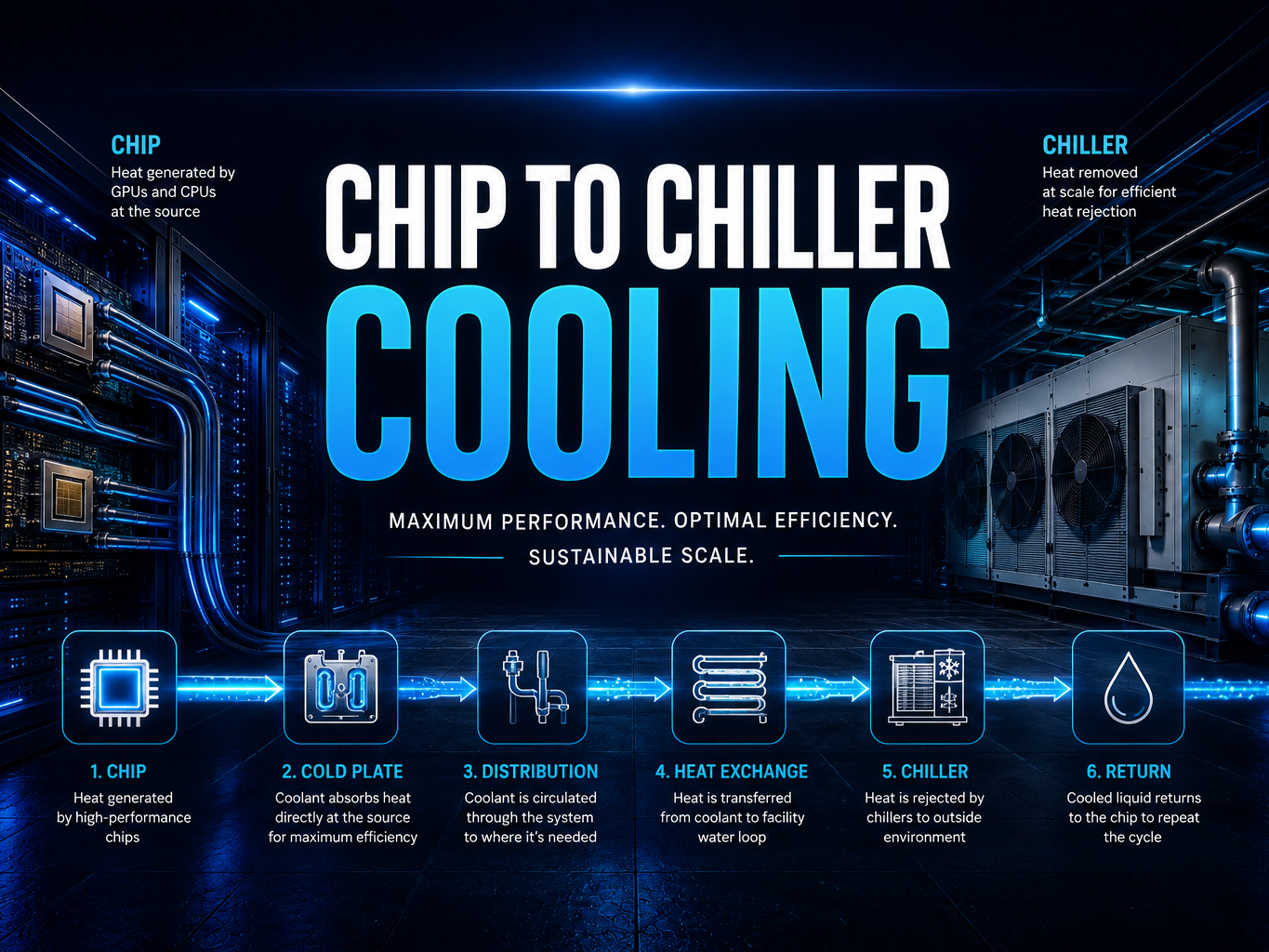
Direct-to-chip: coolant flows through cold plates attached directly to GPUs and CPUs.
Immersion: servers or selected components are surrounded by dielectric cooling fluid.
The right solution depends on GPU density, server architecture, facility design, maintenance requirements and deployment goals.
Does Immersion Cooling Use Water?
The immersion fluid itself is typically a dielectric, non-conductive fluid rather than conventional water.
However, the overall facility can still have water requirements depending on how heat is ultimately rejected.
For projects where water consumption is important, the complete cooling architecture should be evaluated from the server through to final heat rejection.
Can Immersion Cooling Be Used in a Data Center?
Yes. Immersion systems can be deployed in dedicated data center environments and can also be considered for certain high-density computing upgrades.
Before deployment, the facility should be evaluated for:
• Power capacity
• Server compatibility
• Floor loading
• Tank configuration
• Fluid handling
• Heat rejection
• Maintenance access
• Fire and safety requirements
Is Immersion Cooling Good for HPC?
Immersion cooling can be suitable for high-performance computing (HPC) where compute density and thermal loads are high.
GPU clusters, scientific computing and other demanding workloads can benefit from cooling architectures designed around high thermal density.
Choosing an Immersion Cooling System
The right system depends on:
• GPU and CPU configuration
• Server compatibility
• Rack and compute density
• Single-phase or two-phase architecture
• Cooling capacity
• Facility infrastructure
• Heat rejection
• Maintenance requirements
• Future expansion
Immersion cooling should be considered as part of the broader data center cooling and infrastructure strategy, rather than as a standalone technology.
Planning High-Density AI or HPC Infrastructure?
Whether you're evaluating immersion cooling for GPU clusters, AI servers or HPC, the right system starts with your compute and thermal requirements.