What Is Chip-to-Chiller Cooling Architecture?
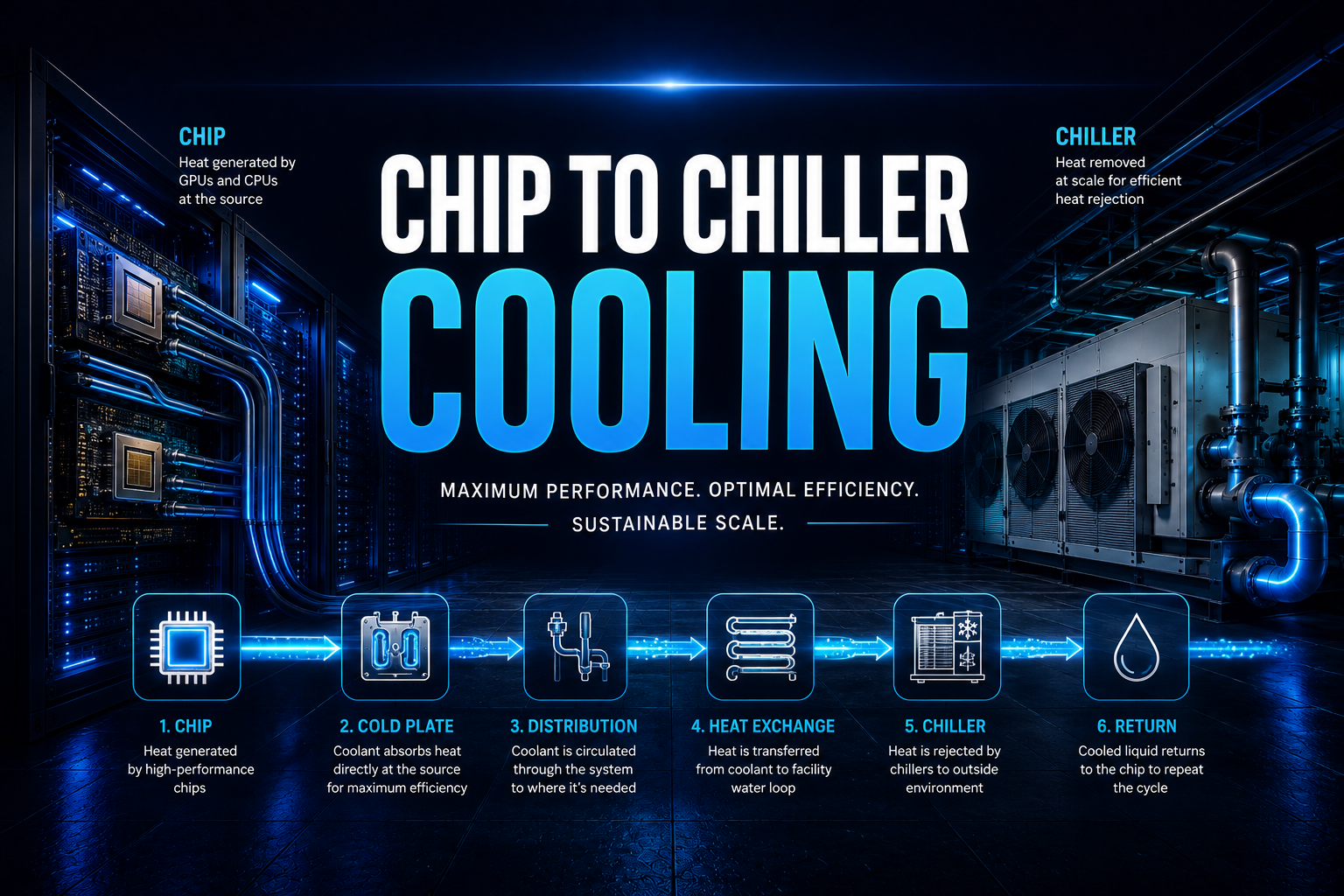
Chip-to-chiller cooling architecture is an end-to-end liquid cooling approach that manages heat from the AI processor or GPU all the way to the facility's heat-rejection system or chiller.
Instead of treating GPU cooling, coolant distribution and facility cooling as separate systems, a chip-to-chiller architecture connects the entire thermal chain.
A simplified cooling path is:
GPU / CPU → Cold Plate → Coolant Loop → CDU → Facility Cooling Loop → Chiller / Heat Rejection
This approach is becoming increasingly important as AI workloads drive higher GPU power and rack densities that can exceed the practical limits of traditional air cooling. Industry reference architectures now increasingly describe AI thermal management as a coordinated system from the chip to the chiller.
How Does Chip-to-Chiller Cooling Work?
A chip-to-chiller system connects several stages of thermal management.
1. Chip-Level Cooling
A liquid-cooled cold plate sits directly against the GPU or CPU.
The coolant absorbs heat generated by the processor and carries it away from the server.
This is the foundation of direct-to-chip cooling.
2. Server & Rack Cooling
Coolant moves through manifolds and distribution infrastructure within the server and rack environment.
Depending on the design, additional components may also require cooling or complementary air cooling.
3. Coolant Distribution Unit
The Coolant Distribution Unit (CDU) acts as an important interface between the technology cooling loop and the facility cooling loop.
It manages coolant circulation, temperature and heat transfer while helping isolate the IT-side cooling loop from the facility-side system.
4. Facility Cooling Loop
Heat transferred through the CDU moves into the facility cooling infrastructure.
This can include:
• Heat exchangers
• Chilled-water loops
• Dry coolers
• Cooling towers
• Chillers
• Other heat-rejection systems
5. Chiller & Heat Rejection
The final stage removes heat from the facility cooling system and rejects it to the external environment.
The exact architecture depends on climate, cooling technology, water availability, efficiency requirements and facility design.
Why Is Chip-to-Chiller Architecture Important for AI?
AI infrastructure is changing the thermal requirements of data centers.
High-performance GPUs generate substantially more heat than many conventional enterprise processors, while high-density AI racks concentrate that heat into a much smaller physical footprint.
This means cooling can no longer be considered only at the server or rack level.
The entire thermal path matters.
A poorly coordinated system can create bottlenecks between the chip, rack, CDU, facility loop and heat-rejection equipment.
A chip-to-chiller approach instead considers the complete system as one thermal architecture. Recent industry research similarly emphasizes the need to connect the thermal path from chip/package through cooling devices and CDUs to facility heat rejection.
What Are the Main Components of a Chip-to-Chiller System?
A typical architecture can include:
• GPU / CPU
The primary source of heat.
The primary source of heat.
• Cold Plate
Transfers heat directly from the processor into the coolant.
Transfers heat directly from the processor into the coolant.
• Manifold & Piping
Moves coolant through the server and rack.
Moves coolant through the server and rack.
• Coolant Distribution Unit (CDU)
Controls and transfers heat between cooling loops.
Controls and transfers heat between cooling loops.
• Facility Cooling Loop
Moves heat away from the IT environment.
Moves heat away from the IT environment.
• Heat Exchanger
Transfers thermal energy between fluid circuits.
Transfers thermal energy between fluid circuits.
• Chiller / Heat Rejection
Ultimately removes heat from the facility.
Ultimately removes heat from the facility.
The exact configuration varies depending on the data center and workload.
Chip-to-Chiller vs. Traditional Data Center Cooling
Traditional data center cooling often treats the server, room and cooling plant as relatively distinct systems.
With high-density AI, that separation becomes increasingly difficult.
Traditional approach
Server → Air → CRAC / CRAH → Chiller
Chip-to-Chiller approach
GPU → Liquid → CDU → Facility Loop → Chiller / Heat Rejection
The second architecture allows thermal management to begin directly at the source of heat.
This is why liquid cooling has become increasingly important for high-density AI infrastructure.
Is Chip-to-Chiller the Same as Direct-to-Chip Cooling?
No.
Direct-to-chip cooling is one component of a chip-to-chiller architecture.
Think of it this way:
Direct-to-chip = how you capture the heat.
Chip-to-chiller = how you manage the heat across the entire system.
A complete architecture can therefore include direct-to-chip cooling alongside CDUs, facility loops, heat exchangers, chillers and heat rejection.
This distinction is important when designing AI data center infrastructure because optimizing one component does not necessarily optimize the complete thermal system.
What Are the Benefits of a Chip-to-Chiller Architecture?
A properly designed architecture can help organizations:
Support Higher GPU Density
Liquid cooling allows heat to be captured closer to increasingly powerful processors.
Improve Thermal Management
The cooling system can be designed around the complete thermal path rather than individual components.
Improve Efficiency
Optimizing pumps, temperatures, heat exchangers and chillers together can improve overall cooling performance.
Increase Scalability
The architecture can be designed to accommodate increasing GPU power and future AI workloads.
Reduce Infrastructure Bottlenecks
Coordinating the chip, CDU and facility cooling system helps prevent one part of the thermal chain from limiting the overall deployment.
Can Chip-to-Chiller Cooling Be Waterless?
It can be designed as part of a water-efficient or waterless cooling architecture, depending on the facility's heat-rejection system.
The fact that liquid cooling is used at the chip does not automatically mean the facility must consume large quantities of water.
Closed-loop cooling, dry coolers and other heat-rejection technologies can be incorporated depending on the project.
The important distinction is between the coolant circulating through the IT equipment and the facility's overall water consumption.
For water-constrained AI deployments, the complete chip-to-chiller architecture should therefore be evaluated rather than looking only at the chip-level cooling technology.
Is Chip-to-Chiller Cooling Suitable for AI Data Centers?
Yes. It is particularly relevant to high-density AI and HPC environments where GPU power and rack density make thermal management a critical infrastructure consideration.
A modern AI data center should evaluate:
• GPU power
• Rack density
• Coolant temperature
• CDU capacity
• Facility cooling capacity
• Chiller efficiency
• Heat rejection
• Water availability
• Future GPU generations
The cooling system should be designed with the compute architecture, rather than added after the GPU infrastructure has been selected.
Designing a Chip-to-Chiller Cooling Architecture
The most effective approach is to treat cooling as a complete infrastructure system.
Chip → Rack → CDU → Facility Loop → Chiller → Heat Rejection
Each stage affects the performance of the next.
For AI infrastructure, this means cooling engineers, data center designers and IT infrastructure teams need to work from the same thermal requirements.
The goal isn't simply to cool the GPU. It's to move heat efficiently from the GPU all the way out of the facility.
Frequently Asked Questions
What does chip-to-chiller mean?
It describes the complete thermal management path from the processor or GPU through liquid cooling, CDUs and facility cooling infrastructure to the final heat-rejection system.
What is the difference between chip-to-chiller and direct-to-chip?
Direct-to-chip describes cooling the processor directly with a liquid-cooled cold plate. Chip-to-chiller describes the complete thermal system from the processor to the chiller or heat-rejection equipment.
What is a CDU in chip-to-chiller cooling?
A Coolant Distribution Unit manages coolant flow and heat transfer between the IT cooling loop and the facility cooling loop.
Is chip-to-chiller only for AI?
No. It can be used for HPC and other high-density computing environments, but AI is a major driver because of increasing GPU power and rack density.
Can chip-to-chiller cooling be waterless?
Potentially. The overall water consumption depends primarily on the facility-side heat-rejection architecture.
Does chip-to-chiller replace air cooling?
Not necessarily. AI data centers can use liquid, air or hybrid cooling, depending on the workload and components being cooled.
Planning High-Density AI Infrastructure?
Cooling is becoming an infrastructure architecture problem, not simply a server-room problem.
If you're evaluating AI data center cooling, direct-to-chip cooling, liquid cooling, CDUs or high-density GPU infrastructure, the complete thermal chain should be considered from chip to chiller.
Want to know more? Contact us.