
GPU Server Cooling for AI & High-Density Compute
What Is the Best Cooling for GPU Servers?
GPU server cooling is the thermal infrastructure used to remove heat generated by high-performance GPUs and CPUs inside AI, HPC and high-density computing systems.
As GPU power increases, traditional air cooling can become increasingly difficult to scale. Liquid cooling, direct-to-chip cooling and hybrid architectures provide efficient options for managing higher GPU thermal loads.
The right solution depends on GPU power, server configuration, rack density and facility infrastructure.
Want to know more? Contact us.
How Does GPU Server Cooling Work?
A modern liquid-cooled GPU server can use:
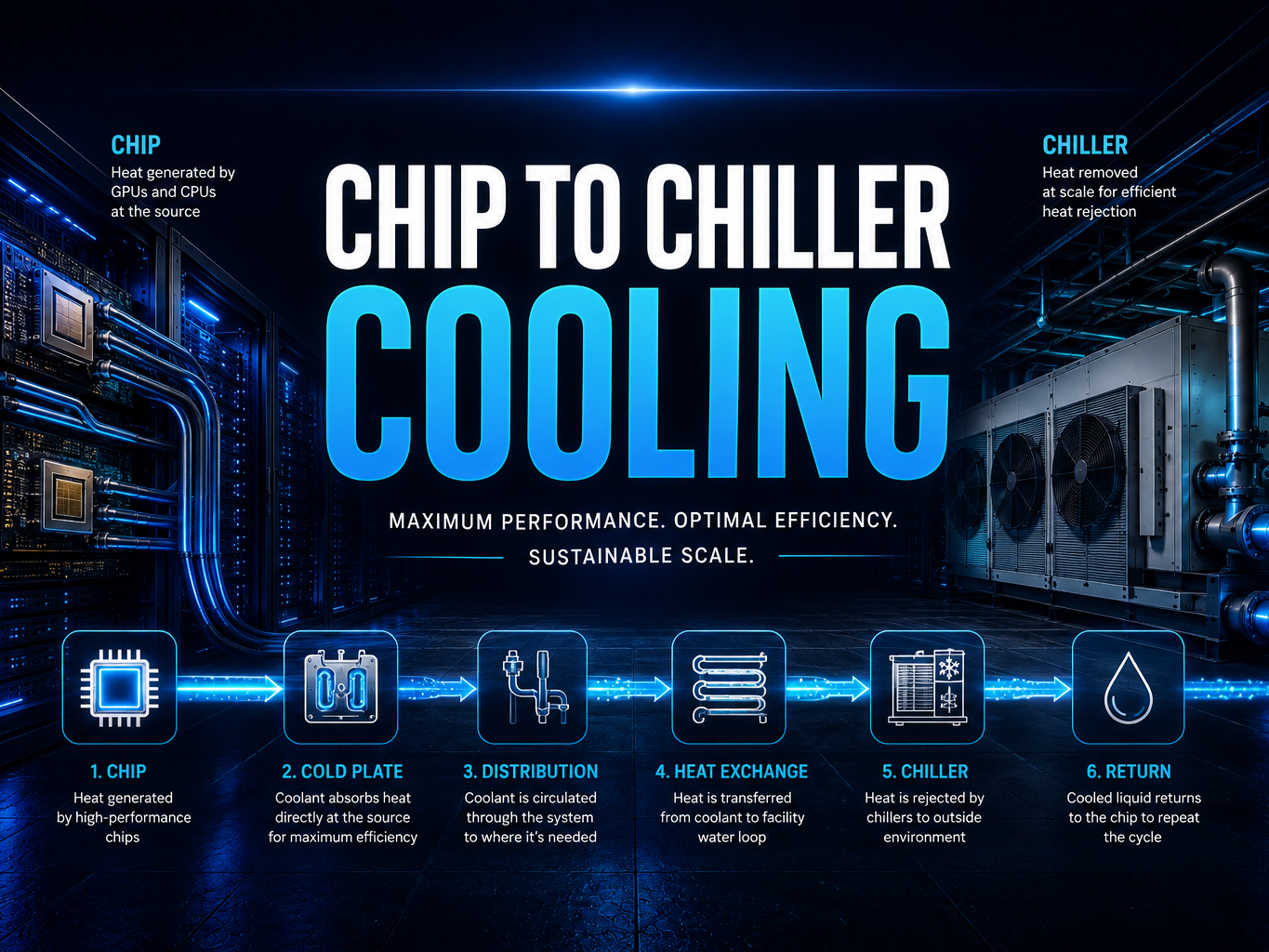
GPU → Cold Plate → Coolant Loop → CDU → Facility Cooling → Heat Rejection
A cold plate transfers heat directly from the GPU into the coolant. The heated coolant then moves through the cooling system, where the heat is transferred to the facility cooling infrastructure.
This approach is particularly relevant for high-density AI GPU servers and HPC systems.
Air Cooling vs. Liquid Cooling for GPU Servers
Air cooling remains suitable for many GPU servers, particularly at lower power densities.
Liquid cooling becomes increasingly attractive as GPU power and server density increase.
For high-performance GPU servers, cooling should be considered alongside power, rack density and future GPU requirements.
What Is Direct-to-Chip GPU Cooling?
Direct-to-chip cooling uses a liquid-cooled cold plate mounted directly to the GPU.
It captures heat at the source rather than relying primarily on room air to transport heat away from the server.
This makes it particularly useful for:
• AI GPU servers
• GPU clusters
• HPC servers
• High-density racks
• Next-generation AI infrastructure
Can GPU Servers Be Liquid Cooled?
Yes. Liquid-cooled GPU servers can use direct-to-chip, rear-door or immersion-based architectures depending on the server and facility design.
The cooling solution should be matched to:
• GPU platform
• GPU power
• Number of GPUs
• Server configuration
• Rack density
• Cooling capacity
• Facility infrastructure
Can GPU Server Cooling Be Retrofitted?
Potentially.
Existing data centers can sometimes integrate liquid-cooled GPU servers, but the available power, cooling, piping, rack configuration and heat-rejection capacity should be evaluated first.
A hybrid approach can also combine air cooling with liquid cooling for the highest-power GPU servers.
GPU Server Cooling for AI Infrastructure
As AI workloads demand increasingly powerful GPUs, GPU server cooling is becoming a core infrastructure consideration.
The objective is simple:
Keep the GPUs within their required operating conditions while supporting the highest practical compute density.
For larger deployments, GPU cooling should be designed as part of the complete infrastructure:
GPU Server → Rack → CDU → Facility Cooling → Heat Rejection
Explore GPU Data Center Infrastructure →
Frequently Asked Questions
What is GPU server cooling?
GPU server cooling removes heat generated by GPUs and other high-performance processors using air, liquid or hybrid cooling technologies.
Do GPU servers need liquid cooling?
Not always. However, liquid cooling becomes increasingly relevant as GPU power and server density increase.
What is the best cooling for GPU servers?
There is no universal answer. Air, direct-to-chip, immersion and hybrid cooling can all be appropriate depending on GPU power and deployment requirements.
What is a liquid-cooled GPU server?
A liquid-cooled GPU server uses liquid to remove heat from GPUs, typically through cold plates or another liquid cooling architecture.
Can GPU server cooling support AI clusters?
Yes. Liquid and direct-to-chip cooling are particularly suited to high-density GPU clusters used for AI and HPC.
Planning High-Density GPU Infrastructure?
The GPU is only part of the equation. Power, cooling and rack density determine how effectively GPU compute can operate at scale.